
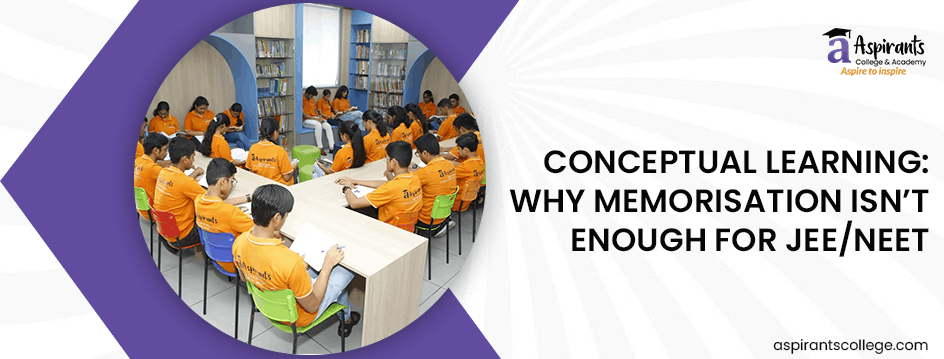
Conceptual Learning: Why Memorisation Isn’t Enough for JEE/NEET
Preparing for competitive examinations like JEE and NEET is no longer just about studying harder; it is about studying smarter. Every year, lakhs of students dedicate countless hours to memorising formulas, reactions, definitions, and shortcuts, believing that rote learning alone will guarantee success. However, modern entrance examinations are evolving rapidly.
Competitive examinations require students to apply knowledge logically under pressure, making conceptual learning the true key to success. To crack JEE or NEET, aspirants must move beyond passive learning and focus on understanding the “why” behind every concept with the support of the best JEE Main coaching center Kalyan.
JEE and NEET papers are designed to assess analytical thinking, conceptual clarity, and problem-solving abilities rather than simple memory recall. Students often discover that, despite memorising entire chapters, they struggle when questions are twisted, application-based, or presented in unfamiliar formats. This happens because memorisation may help in recalling information temporarily, but it rarely develops a deep understanding of concepts.
The Limitation of Memorisation
Memorisation has always been a common study technique among students. It feels productive because repeating information several times creates familiarity. However, this approach has serious limitations, especially in highly competitive examinations.
JEE and NEET questions are rarely direct. Examiners intentionally frame questions in ways that test whether students genuinely understand the concept or have merely memorised facts. A student who relies only on memorisation may perform well in theory-based questions but struggle badly when concepts are applied in real-world or multi-step problems.
For instance, memorising Physics formulas without understanding their derivation often creates confusion when students need to decide which formula applies to a particular situation. Similarly, in Chemistry, learning reactions by heart without understanding reaction mechanisms makes it difficult to solve advanced organic chemistry questions.
Memorisation also increases stress levels. Since information is stored superficially, students frequently forget details during examinations. This creates panic and negatively affects performance. In contrast, conceptual understanding developed with the support of the best coaching for NEET helps students logically rebuild answers even if they momentarily forget specific details.

Why Conceptual Learning Matters
Conceptual learning focuses on understanding the logic, principles, and relationships behind topics. Instead of simply remembering information, students learn how and why things work with the help of the best JEE Main coaching center Kalyan.
This approach is extremely important for JEE and NEET because both examinations test application-based knowledge. Questions often combine multiple concepts from different chapters, requiring students to think critically and connect ideas.
When students develop conceptual clarity:
- They solve problems faster.
- They make fewer mistakes.
- They retain information for longer periods.
- They gain confidence in unfamiliar questions.
- They improve analytical thinking skills.
In Physics, conceptual learning helps students visualise situations and apply laws naturally. In Chemistry, it enables a better understanding of reactions and numerical calculations. In Biology, conceptual understanding helps students connect systems, processes, and functions instead of memorising isolated facts.
Conceptual learning also prepares students for future academic challenges. Engineering and medical education require deep understanding, not surface-level memorisation. Students who focus on concepts during JEE and NEET preparation often adapt better in higher education.
The Changing Pattern of JEE and NEET
Over the years, examination patterns have become increasingly application-oriented. Questions now demand reasoning, interpretation, and multi-concept integration.
In JEE, students face complex numerical and analytical problems where direct formula application is rarely enough. Questions often test whether students can manipulate concepts under varying conditions.
Similarly, NEET has gradually shifted towards assertion-reasoning, case-based, and conceptual MCQs. Biology, once considered a memory-heavy subject, now requires better conceptual understanding to answer tricky questions accurately.
This change reflects a larger educational shift. Institutions want future engineers and doctors who can think critically, solve problems, and understand practical applications, not just students who can memorise textbooks.
As a result, students who prioritise conceptual learning gain a major competitive advantage with the support of the best JEE Main coaching center Kalyan.
How Students Can Build Conceptual Clarity
Understand Before Memorising
Students should first focus on understanding the concept thoroughly before attempting to memorise formulas or definitions. Asking questions like “Why does this happen?” and “How is this derived?” improves comprehension significantly.
Practise Application-Based Questions
Solving different types of questions strengthens conceptual understanding. Students should expose themselves to advanced and unfamiliar problems rather than repeatedly solving only standard textbook exercises.
Use Visual Learning Techniques
Diagrams, flowcharts, animations, and practical examples make concepts easier to understand and remember. Visual learning is especially useful for Physics and Biology.
Revise Concepts Regularly
Conceptual learning does not eliminate revision. Regular revision strengthens understanding and helps students retain information effectively over time.
Teach Others
One of the best ways to test conceptual clarity is by explaining topics to someone else. Teaching forces students to simplify and organise their understanding logically.
Focus on Mistake Analysis
Instead of simply checking whether an answer is correct or wrong, students should analyse why mistakes occur. This improves conceptual depth and prevents repeated errors.
Role of Teachers and Coaching Institutes
Teachers play a crucial role in developing conceptual understanding among students. A good mentor encourages curiosity, logical thinking, and problem-solving rather than promoting blind memorisation.
Effective coaching institutes create environments where students are encouraged to ask questions freely and explore concepts deeply. Interactive classes, doubt-solving sessions, regular assessments, and personalised guidance from the best Institution for JEE help students strengthen their fundamentals.
Modern preparation strategies also involve mock tests, performance analysis, and structured study routines that focus equally on understanding and application.
Balancing Memorisation and Understanding
Although conceptual learning is essential, memorisation still has a role in JEE and NEET preparation. Certain formulas, reactions, biological terminologies, and factual information must be remembered accurately.
However, memorisation should support understanding, not replace it.
The ideal preparation strategy combines:
- Strong conceptual foundations
- Smart revision techniques
- Regular practice
- Strategic memorisation
Students who achieve this balance perform far better than those who rely entirely on rote learning.
Final Thoughts
Success in JEE and NEET is no longer determined by how much a student can memorise. The real challenge lies in understanding concepts deeply and applying them effectively under pressure. Conceptual learning develops critical thinking, improves confidence, enhances retention, and prepares students for long-term academic success.
Students who invest time in building strong fundamentals often find themselves better equipped to handle difficult and unexpected questions. Instead of chasing shortcuts and rote methods, aspirants should focus on learning with clarity, curiosity, and consistency with the best JEE Main coaching center Kalyan.
For students seeking structured guidance, expert mentorship, and a concept-focused learning environment, they can reach out to us at Aspirants College & Academy. We offer valuable resources, academic support, and preparation strategies designed to help aspirants excel in competitive examinations like JEE and NEET. Visit us now to get more insights.